-

Tourismuskarte Rom
Tourismuskarte Rom
Rom wurde zwar nicht an einem Tag erbaut, aber Sie können das Beste davon an nur einem Tag sehen! Sichern Sie sich die Rom Tourist Card und Sie sind mit Ihrer Touristenkarte für Rom für die wichtigsten Orte in Rom bestens gerüstet.
Weiterlesen... -
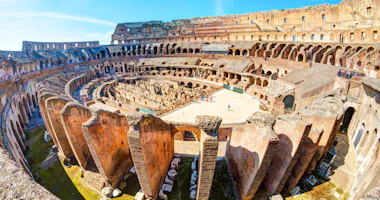
Kolosseum, Forum Romanum & Palatinhügel: Priorisierter Eintritt
Kolosseum, Forum Romanum & Palatinhügel: Priorisierter Eintritt
Besuchen Sie das Kolosseum und erhalten Sie Zutritt zu dem normalerweise gesperrten Bereich der Arena, auf dem die Gladiatoren um ihr Leben kämpften. Erkunden Sie das Forum Romanum und den Palatinhügel.
Weiterlesen... -

Vatikanische Museen & Sixtinische Kapell
Vatikanische Museen & Sixtinische Kapell
Michelangelos Fresken in der Sixtinischen Kapelle gelten gemeinhin als das großartigste jemals erschaffene Kunstwerk – sie allein sind den Eintritt in die Sixtinische Kapelle und das Ticket für die Vatikanischen Museen wert
Weiterlesen... -

Galleria Borghese: Reservierter Eintritt
Galleria Borghese: Reservierter Eintritt
Villa & Galleria Borghese in Rom: einst Privatsammlung von Kardinal Scipione Borghese, dessen Büste dort zu sehen ist. Zu sehen sind Caravaggios Hell-Dunkel-Gemälde wie „Heiliger Hieronymus“ und „Junge mit Früchtekorb“ sowie Berninis „David“.
Weiterlesen...

Aquäduktpark
Nicht jeder Park in Rom wird von Touristenströmen überflutet. Tatsächlich zählt Rom zu den grünsten Städten Europas, und viele seiner Parks sind von Gelegenheitsbesuchern bis heute unentdeckt geblieben. Der Aquädukt-Park ist ein gutes Beispiel für einen faszinierenden Ort, der abseits jeder Touristenroute liegt. Hauptsächlich Jogger nutzen ihn, und einige private Sportvereine haben hier ihr Zuhause gefunden.
Im Park stoßen Sie auf die imposanten Überreste mehrerer antiker Aquädukte aus der Zeit des Römischen Reiches. Mit einer Fläche von rund 240 Hektar liegt er im Südosten der Stadt. In der Antike bildete diese Gegend einen wichtigen Knotenpunkt für die Wasserversorgung des städtischen Gebiets.

Water supply was considered essential in every Roman city plan. The state-of-the-art mastery gained by the architects has been used not only in Rome, but in plenty of cities founded during all over the Roman Empire. The aqueducts were so robust, that many have survived until the present day. You can find remains of those structures in Italy, Spain, France, Germany, Turkey and Israel. They were built using overlapping arches. The water ran in a groove at the top, and the system worked using the force of gravity. Some of those aqueducts run for tens of kilometers with a gradient of only about 30 cm for each kilometer of length. This highly specialized and precise technology remained unsurpassed for more than 1,000 years after the Roman Empire’s decline.
Unfortunately, this area has been neglected for many years and, from the ‘50s, it was partially occupied with a slum. In the ‘70s, the barracks and unauthorized small houses were removed, and the site officially became a park. Still, the area has had its ups and downs with regards to maintenance, until it became part of the wider complex of the Appia Antica Park. In Italian, the name of this park is Parco degli Acquedotti .


On top of the aqueducts, there are a number of ruins of towers, villas, tombs and also some parts of a Roman road.
The Park’s Attractions
The Aqueducts
Vetus Aqueduct
The Vetus Aqueduct is one of the oldest aqueducts in this park.·The water of this aqueduct came directly from the river Aniene (near the town of Tivoli).
Tepula Aqueduct
The Tepula Aqueduct has been built during the Republican era, in 125 BC. Its name “Tepula” is Latin for “tepid”, because the temperature of the water at the source was at about 17° C.
Anio Novus Aqueduct
The Anio Novus Aqueduct is one of the longest aqueducts of this park with a length of about 87 km. However, most of it is not visible, as·approximately 73 km of this structure runs below the ground. Its construction began under the emperor Caligola in 38 AD and ended under Claudio in 52 AD.
Claudius Aqueduct
Thanks to the technology used for its construction, the Claudius Aqueduct is considered one of the most important aqueducts of the Eternal City. The section that you’ll be able to see in the park is actually the most well preserved of its entire original 46 km of length. It was built between 38 and 52 AD by the emperors Caligola and Claudio, in the same years of the aqueduct Avio Novus, as the water supply had to be increased because of the rapid growth of the city.
Julia Aqueduct
The Julia Aqueduct was made by a building contractor and loyal friend of the Emperor Augustus in 33 BC. That’s why the structure is dedicated to the emperor’s family, the Gens Julia. The water comes from the town of Grottaferrata, located at approximately 20 km South East of Rome.
Aqua Marcia Aqueduct
The Aqua Marcia Aqueduct’s route runs partly below the ground and partly above the ground over arches.·It’s about 90 km long and it was built by the Praetor Quinto Marcio Re in 144 BC.
Felice Aqueduct (Aqua Felix)
Compared with the other aqueducts, this one is relatively modern, as it has been built in 1586 by will of Pope Sixtus V. Through this aqueduct, the Roman hills of Viminale, Quirinale and Esquilino, together with the splendid Villa Montalto, had a constant supply of clean water. The Montalto palace was a monumental mansion in the center of Rome, privately owned by the pope’s family, which was later demolished to build the Termini Station and residential buildings in the Rione of Castro Pretorio.


Other Attractions
Casale Roma Vecchia
Casale Roma Vecchia's main structure dates back to the year 1200. Originally this house/tower was used for defense purposes and to control the nearby Aqueducts Claudio and Marcio. Later, it was converted into a farm.
Torre del Fiscale
Built around 1200 – 1300, and about 30 meters in height, this is a well preserved tower of the Middle Ages. It is situated at the intersection between five different aqueducts. The tower was built as a lookout post to guard the landed estates and the crops of the noble Roman families . The area around it, is named after this building, and it’s called Parco di Tor Fiscale.
Villa dei Sette Bassi
This large archaeological site has been only partially investigated. It was one of the largest complexes of the Roman suburbs. It was built in the second century AD and included three large buildings and a huge hippodrome-garden and it was inhabited up to the fourth century. The villa is not accessible to the visitors yet.
Via Latina
This ancient road connected Rome to the city of Capua, in the Campania region. The road was 240 km long and it’s considered one of the most ancient routes in the Lazio area: the Etruscans had used the same path to colonize areas of the Campania region. In the park, you’ll find some parts of the old via Latina road built during the Roman Empire, along with tombs, farms, Roman villas and medieval towers.
Fosso Acqua Mariana
Fosso Acqua Mariana is an artificial ditch that was used as an alternative to the aqueducts, mainly for the Saint John in Lateran orchards irrigation. Fosso Acqua Mariana was built in 1122 by Pope Calixtus II.

Torre di Guardia su Cisterna
Torre di Guardia su Cisterna is a tower built in 1200 to as a guard post for the Fosso Acqua Mariana.
Casale Del Sellaretto
This old roadhouse was built next to an old railroad by the Pope Pius IX in 1856, and it was mainly used as a store at the track. When the new railroad Rome-Naples was finished, this building fell into disrepair.
Cisterna della Villa delle Vignacce
Next to the Aqua Marcia Aqueduct and to the ancient Villa delle Vignacce, it is possible to visit the ruins of the two-storey tank that used to supply water to the nearby large complex.
How to Get to The Aqueduct Park and Travel Tips
You can arrive here by subway (Metro Line A – Anagnina Direction) and get off at the stop called Giulio Agricola. Then, walk down Viale Giulio Agricola Street. One of the park’s entrances is at the end of the street. We suggest that you visit this park during the day, and avoid walking around it after sunset. The park is very large, with no fencing or gates, poor artificial lighting (especially in some areas) and no surveillance. Some people may take their dog off the leash for a run, so be aware of that, especially if you are traveling with children.

FAQ
-
Was ist der Aquädukt-Park?
Der Aquädukt-Park (Parco degli Acquedotti) liegt im Südosten Roms und erstreckt sich über eine große Fläche. Hier stoßen Sie auf die Überreste zahlreicher Aquädukte aus der Zeit des Römischen Reichs, aber auch auf weitere Zeugnisse der Vergangenheit wie Gebäude, Grabmäler und einen mittelalterlichen Turm.
-
Warum sind die römischen Aquädukte so berühmt?
Die herausragende Ingenieurskunst der römischen Baumeister kam nicht nur in Rom selbst zum Einsatz, sondern auch in vielen Städten, die während des Römischen Reichs gegründet wurden. Diese Bauwerke entstanden mit bemerkenswerter Präzision: Das Wasser floss oben auf den Arkaden durch eine Rinne mit einem minimalen Gefälle von nur etwa 30 cm pro Kilometer. Manche Aquädukte erstreckten sich über mehrere Dutzend Kilometer.
-
Wie komme ich zum Aquädukt-Park?
Am einfachsten erreichen Sie den Aquädukt-Park mit der U-Bahn (Linie A, Richtung Anagnina) bis zur Station Giulio Agricola. Von dort führt Sie ein kurzer Fußweg direkt zu einem der Parkeingänge.
Auch interessant

Appian Way Regional Park
Der Titel Appia Antica Park ist lediglich eine Kurzform des vollständigen Namens Parco Regionale dell'Appia Antica. Das Gebiet ist bekannt für seine umfangreiche Sammlung an antiken Schätzen, archäologischen Überresten und Ruinen. Entlang der Via Appia und im Parkgebiet finden Sie ebenfalls einige Denkmäler. Jedes der Denkmäler stellt die vielfältige Geschichte Roms dar.
Weiterlesen...
Das Kolosseum
Das Kolosseum ist ein antikes Amphitheater, in welchem ursprünglich Spiele stattfanden. Üblich waren Kämpfe zwischen Tieren, zwischen Mensch und Tier und zwischen Menschen. Neben den blutigen Kämpfen gab es auch Aufführungen von Akrobaten, Flötenspielern und anderen Künstlern.
Weiterlesen...
Gladiatorenschule
Wollten Sie schon immer wissen, wie das Leben eines Gladiators ist? In der römischen Gladiatorenschule erfahren Sie alles über deren Leben, Training und die römischen Spiele.
Weiterlesen...
Villa Borghese
Heute sind in der Villa Borghese mehrere Museen und ein Zoo zu finden. Der Zoo ist 17 Hektar groß. Folgende Museen befinden sich auf den Ländereien der Villa Borghese.
Weiterlesen...